
Agentic Platform Shift Redefines Commerce & How Money Moves
A new commerce model for a new customer type
Commerce accelerates when payment friction is removed. When buying becomes easier, people consume more. We saw this when PayPal accelerated online buying by introducing in-context checkout and when Apple reshaped mobile commerce with seamless in-app payments. Each improvement removed friction, accelerating commerce.
We are now entering the next platform shift to agentic commerce where AI agents are the new type of customers. Today, agents can complete meaningful work inside development tools, automation platforms, and internal workflows. However, when they need access to an external paid service, the workflow stops because existing systems still depend on humans to create the account and complete payment. The success of agentic commerce will require AI native payment capabilities that do not depend on human intervention.
Why agents need AI-native onboarding and payment
The systems that handle onboarding and payments were designed around a headed interaction model, where a human completes UI-driven steps to enter information, confirm choices, manage credentials, and finish checkout. Agents operate in a headless interaction model, executing through APIs, and unable to move through UI-driven flows.
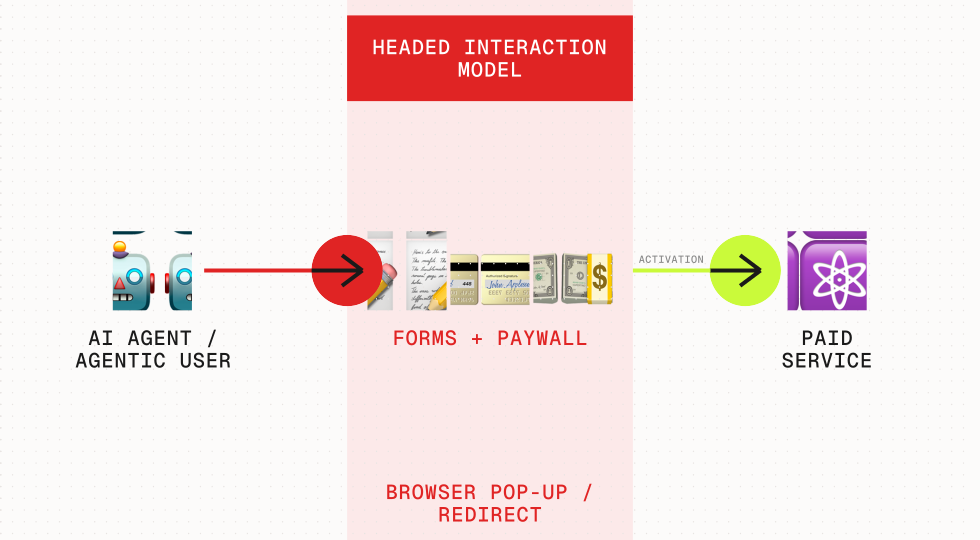
Agents run end-to-end workflows that often depend on external paid services. Today, progress stops when agents hit a headed interaction model. The workflow waits for a human to complete the signup, verification, or billing steps. When this happens, agentic work stalls, revenue opportunities are lost, and a human has to step in to complete the UI-centric steps so the workflow can continue.
This is a repeated bottleneck in today’s agentic workflows. Agents can execute the work but cannot move past the human-centric gates that control access and payment. Merchants and marketplaces have no mechanism to treat an AI agent as a customer, so they rely on human-centric systems that create friction and stall the work.
What changes when agents can execute onboarding and payments
When agents can onboard, evaluate and select products, and complete payment independently, the workflow moves forward without interruption. All activity stays within the originating environment, while steps that once depended on human intervention are seamlessly absorbed into the agent-driven workflow.
For businesses, the benefits are straightforward. Agents can be onboarded as a new customer type autonomously, purchase intent converts directly into revenue, and products/services can be monetized at the speed of AI.
Agent owners also benefit because they no longer need to preconfigure accounts, keys, or billing details for every service an agent may use. The agent handles its own access and billing, which reduces a meaningful amount of operational setup and ongoing maintenance for the owner.

Enabling agents to execute onboarding and payments is not a convenience feature. It is what allows an agent to participate as a customer rather than a workflow that pauses whenever a human-only step appears. When onboarding and payment are agent-driven, they enable an AI-native commerce model that creates a net-new revenue line for the business.
Why InFlow exists
Most of the industry has spent its energy improving agent intelligence and building better orchestration. Those advances matter, but they do not address the limitation that keeps agents and businesses from participating in agentic commerce. The systems responsible for onboarding and payment were built for human users. They expect someone to go through a headed interaction model to enter information, manage credentials, and confirm transactions. Agents interact with systems through a headless interaction model, so they cannot move through today’s purchase flows or become paying customers.
Using today’s headed interaction model, agentic workflows stop. The business loses the sale and the workflow stalls until a human steps in. As these systems scale, managing and provisioning accounts for agents becomes unmanageable.
InFlow removes the bottleneck by letting agents onboard and pay on their own. Identity, access, and payment run automatically under policy control, so agents can use external services the moment their workflow calls for them.
InFlow gives online businesses the infrastructure to support a new customer type: AI agents. With InFlow, workflows stay continuous and businesses capture revenue at the moment demand appears. InFlow enables AI-native commerce and converts agent-driven activity into revenue.
The path forward
It is still early, and the shape of agentic commerce will continue to evolve. What will not change is the need for infrastructure anchored in trust, identity, and reliable payment. We are building toward that future and look forward to collaborating with our customers and partners.
— Jim Nguyen, Co-founder and CEO @ InFlow